
Pages For Salvador Bahia Brasil Resources for Travel in Brazil

Showing posts with label candomble. Show all posts

Tuesday

FESTA NOSSA SENHORA DA BOA MORTE FESTIVAL

Fest Nossa Senhora da Boa Morte (Order of Our Lady of the Good Death)
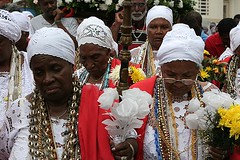
festa nossa senhora da boa morte
The Festa Nossa Senhora da Boa Morte A.K.A. Boa Morte Festival is an incredible event to witness!  The Irmandade da Nossa Senhora da Boa Morte means Order of our Lady of the Good Death.  It is a Candomble sorority that has been going strong for nearly two hundred years.

Once every year the sisterhood of Nossa Senhora da Boa Morte holds an event where the Virgin Mary is marched through the town while festivities celebrating this colorful event take place.  (read below for more info)
with the family at the festa nossa senhora da boa morte festival

I have witnessed the Nossa Senhora da Boa Morte Festival and it was very impressive.  People from all over the world come to this small town called Cachoeira to witness this event.  Click this link if you would like to attend this wonderful event.

This article can be found @ Wikipedia here.

The Order of Our Lady of the Good Death (Irmandade da Nossa Senhora da Boa Morte) is a small but renowned Afro-Catholic religious group in the state of Bahia, Brazil.

Founded in the early 19th century as a Church-sponsored beneficent Sisterhood for female African slaves and former slaves, it became one of the oldest and most respected worship groups for Candomblé, the major African-based religion in Brazil. Presently reduced to about thirty members (from 200 or so at its height), most of them over fifty, it still attracts worshipers every year, especially at its August festival.

History of the Festa Nossa Senhora da Boa Morte A.K.A. Boa Morte Festival

The history of the Irmandade da Boa Morte ("Sisterhood of the Good Death"), a religious confraternity devoted to the Assumption of the Virgin, is part of the history of mass importation of blacks from the African coast to the cane-growing catchment area around the port of Salvador, Bahia, known as the Recôncavo Baiano. Iberian adventurers built several towns in this area, one of them being Cachoeira, which was the second most important economic center in Bahia for three centuries.

Thursday

Orishá Statues at Dique Do Tororo | Orixás Candomble in Bahia Brasil


The orishá live in Bahia, Brasil. They are alive and well. This is especially evident in Salvador, the state capital of Bahia. Depictions of the orishá (orixás alt. spelling), are found in the various ruas (streets) and plazas of Salvador, Bahia, Brasil. They are literally visible throughout the city.  The Orishá are the deities of the Afro-Brazilian religion Candomble.

Orishá Statues at Dique Do Tororo | Orixás Candomble in Bahia Brasil
One example is the painted mermaid statue in the neighborhood of Rio Vermelho associated with Yemanja, mother goddess figure, which overlooks the sea. Another example is the statue of Exu, the orishá who manages all types of communication and guardian of the crossroads, which is located, fittingly, in front of Salvador’s central correiro (post office).

impressive orishá statues of candomble at dique do tororo
One of the most impressive depictions of the orishá, however, is located on a big lake and recreation park in the middle of the city called Dique do Tororo, which contains a group of orishá statues dancing in a circle on the surface of the water. Dique do Tororo looks just as impressive as it sounds.
boat tour of the orixás candomble at dique do tororo

Throughout this article you will see photos taken by my wife while visiting Dique do Tororo with a friend. She took a boat tour that is available daily for only $20 reais. We definitely recommend the boat tour for anyone visiting Bahia, Brasil. Be sure to check out our Bahia Tour site to schedule any tours in Bahia.


First let’s talk a little about "The Most African City of Brazil", Salvador, Bahia.

Friday

CANDOMBLÉ

Candomblé


This was taken from Wikipedia.
Candomblé is an African-originated or Afro-Brazilian religion, practised chiefly in Brazil by the "povo de santo" (people of saint). It originated in the cities of Salvador, the capital of Bahia and Cachoeira, at the time one of the main commercial crossroads for the distribution of products and slave trade to other parts of Bahia state in Brazil. Although Candomblé is practiced primarily in Brazil, it is also practiced in other countries in the Americas, including Uruguay, Argentina, Venezuela, Colombia, Panama and Mexico, and in Europe in Germany, Italy, Portugal and Spain.

The religion is based in the anima (soul) of Nature, and is also known as Animism. It was developed in Brazil with the knowledge of African Priests that were enslaved and brought to Brazil, together with their mythology, their culture and language, between 1549 and 1888.

The rituals involve the possession of the initiated by Orishas, offerings and sacrifices of the mineral, vegetable and animal kingdom, healing, dancing/trance and percussion. Candomblé draws inspiration from a variety of people of the African Diaspora, but it mainly features aspects of Yoruba orisha veneration.

Overview

In many parts of the Latin America, Orishás are now conflated with Roman Catholic saints. This religion, like many African religions, is an oral tradition and therefore has not been put into text throughout the years. Only recently have scholars and people of this religion begun to write down their practices. The name Batuque is also used, especially before the 19th century when Candomblé became more common. Both words are believed to derive from a Bantu-family language, mainly that of (Kongo Kingdom).

Candomblé may be called Macumba in some regions, notably Rio de Janeiro and São Paulo, although

You Might Also Like:

Related Posts Plugin for WordPress, Blogger...