The food from Brazil is just as interesting and diverse as the people and landscape of this thriving melting pot. There has been heavy influence from the various immigrants to the country as well as the indigenous population.
This post will focus on the heavy Moorish influence on Brazilian cuisine coming from an interesting mix of Portugal, African slaves, and Arab immigrants. Portugal at the time of the colonization of Brazil was a nation
recovering from a lengthy period of Moorish occupation. Many of the colonist were Christianized Moors, or moriscos. Also, a little known fact is that Brazil has the largest Arab population outside of the Middle East.
The Moorish Influence on Food From Brazil
The Moorish influenced remained in Portuguese culture as evident in the cuisine and language. Many Portuguese words have Arabic roots such as orange (
laranja in Portuguese; from the Arabic
naranj نارنج) and rice (
arroz in Portuguese; from the Arabic
al-ruzz). Both rice and oranges were brought to Spain and Portugal by the Moors.
The Arab influence is so deeply embedded in to Brazilian
culture that most do not realize how prevalent it is. It has just been
integrated as Brazilian. In the main Brazilian cities it is easy to find restaurants that cook Arabic food such as
sfihas (Portuguese
esfirra),
tabbouleh (Portuguese
tabule),
kibbeh (Portuguese
quibe),
hummus,
tahina and
halwa are very well known among Brazilians.
Brazilian mainstays such as cuscuz arrived via African slaves. Cuscuz is a popular dish in Bahia, Brasil.
Couscous is actually the national dish of Morocco.
The term Cuscuz, also spelled cuscus and cuzcuz in Portuguese, refers
to several preparations in different regions of the country. The origin
of the plate is certainly the Middle Eastern couscous, but once it was
introduced to the new tropical culture, several versions using local
ingredients began to develop.
 In Bahia, Brasil Cuscuz can be a plain, steamed, cake-like cereal made with flocos de milho pré-cozidos
(yellow, precooked corn meal - “Milharina”, by Quaker, is a very well
known brand). Usually served for breakfast, it’s made in the cuscuzeira, or cuscuzeiro
(see picture), a steaming pan that has a perforated metal disc with a
handle that seats on top of simmering water where you place the corn
meal, previously moistened with salt water.
In Bahia, Brasil Cuscuz can be a plain, steamed, cake-like cereal made with flocos de milho pré-cozidos
(yellow, precooked corn meal - “Milharina”, by Quaker, is a very well
known brand). Usually served for breakfast, it’s made in the cuscuzeira, or cuscuzeiro
(see picture), a steaming pan that has a perforated metal disc with a
handle that seats on top of simmering water where you place the corn
meal, previously moistened with salt water.
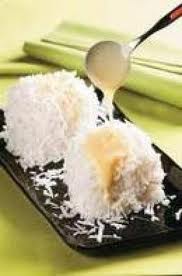 Then, there’s cuscuz de tapioca, a sweet, flan-like version of the dish made with manioc/yucca tapioca pearls, coconut and condensed milk. Source

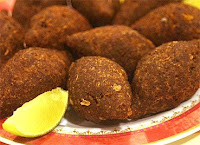 Kibe/Quibe
: extremely popular, it corresponds to the Lebanese dish
kibbeh and was brought to mainstream Brazilian culture by
Syrian and
Lebanese immigrants. It can be served baked, fried, or raw.
It is stuffed with meat or hummus.
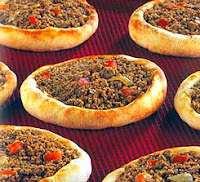 Esfiha
 (Arabic:
sfiha):
another Middle Eastern dish, despite being a more recent addition to
Brazilian cuisine they are nowadays easily found everywhere, specially
in Northeastern, Southern and Southeastern regions. They are pie/cakes
with fillings like beef,
mutton, cheese curd, or seasoned vegetables.
Tabouli is another fixture at salad bars.
West African Flavor of Food From Brazil
The African hand in the Brazilian cooking pot completes the
triptych, most noticeably in the northeastern states, where the
plantation system held greatest sway. There, from virtually the
inception of colonization, Africans were in control of the kitchens
of the Big Houses. In Bahia, Brasil they were from the Bight of Benin and
the Sudanese regions of West Africa. In Rio and Pernambuco, they
were mainly Bantu. All brought their own tastes in food.
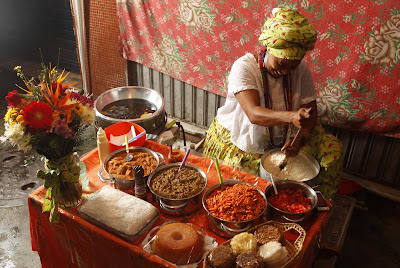 |
| This baiana in Bahia, Brasil is preparing acaraje and has cuscuz as well as cuscuz de tapioca |
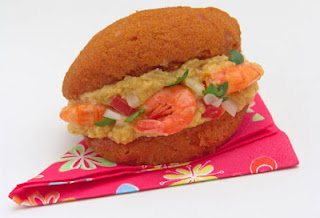 |
| Acaraje, the Brazilian falafel |
The
religious traditions of the African continent crossed the Atlantic
as well, and in the hands of the Big House cooks, many ritual
dishes were secularized and joined the culinary repertoire. The
akara, a bean fritter fried in palm oil by the Yoruba people
of southwestern Nigeria, was transformed into the Brazilian
black-eyed pea fritter, or
acaraje; fon akassa changed only
its spelling to become the
acaca, and the Angolan cornmeal
porridge known as
funji kept its name and its spelling as
the dishes of the African continent were turned into Brazilian
standbys.
African cooks embellished dishes with ginger, chilies, and
pulverized cashew nuts and maintained the tastes of coastal Africa
in the continued use of dried smoked shrimp and palm oil. They
adapted recipes and adopted the ingredients of the new land to
create a cooking so unique that the food of the state of Bahia is
considered by many the linchpin that connects the cooking of Africa
with that of the Western Hemisphere.
Source
Check out the article below from
Islamictourism.com:
Food From Brazilian with an Arab touch
Islamic Tourism – Issue 34 – March-April / 2008
By Habeeb Salloum
In the world of culinary art, Brazil is to Portugal what Mexico is to Spain. These two colonies
in the New World were the crown jewels of their respective motherland. However, in their
cuisines, both carrying deep Arab influences, there is a difference.
Even though many of the original colonists in both countries were Moors newly converted to Christianity, in Brazil, a huge number of African slaves were imported to work on the plantations. A good number were Muslims and their food was saturated with North African influences. The 20th century Arab immigrants to the country added another dimension to Brazilian food. Hence, the Moorish heritage of the Portuguese
.png)

 followed Muslim orientation; Portugal and Spain were Muslims by 800 years until just two years before Cabral having arrived at Brazil ...


